R&D Studio that de-risks
biofabrication innovation.
biofabrication innovation.
Lifefabs Institute is a biofabrication R&D studio that supports companies and research labs in exploring and de-risking biomaterial and bio-based innovations.
We provide space and expertise to rapidly test and develop bio-driven ideas across, healthcare, fashion, textiles and the built environment; without the cost, rigidity, or long timelines of a traditional contract lab,
We prioritise speed and flexibility, enabling a de-risked sandbox for rapid experimental exploration and execution, enabling informed decisions before you scale-up.
Unlike building in-house, you gain immediate access to space, equipment, and materials without the burden of capital investment or recruitment, companies work with us to unlock new possibilities and accelerate innovation with confidence.
We welcome high-impact projects that are often overlooked as too risky, too early-stage, or too niche, as well as frontier ideas that internal teams struggle to justify.
With rapid onboarding and a staged, pilot-first approach, projects begin quickly and generate tangible results before further commitment.
The result is the rigour of a research lab, delivered with the pace and clarity that industry demands.
Whether through project-based collaborations, life science innovation sprints, or long-term partnerships,
Lifefabs acts as a catalyst for translating biological material intelligence into real-world applications.
We provide the space, tools, and interdisciplinary expertise needed to move ideas from concept to tested prototype quickly and effectively.
By combining scientific rigour with creative exploration, we enable partners to navigate uncertainty and unlock new opportunities in bio-based innovation.




Our partners span a broad spectrum, from materials science organisations and creative agencies focused on material innovation and nature-inspired design to hospitals, medical training educators, university institutions, and research labs.
We have collaborated with advanced scientific research institutions, as well as design-led companies, supporting projects that bridge science, technology, and creative practice.
In addition to providing our R&D collaborators with specialist expertise, shared knowledge, and access to our facilities, we place a strong emphasis on knowledge exchange.
By bringing together diverse disciplines, we help translate experimental research into practical, real-world applications and foster innovation across sectors.
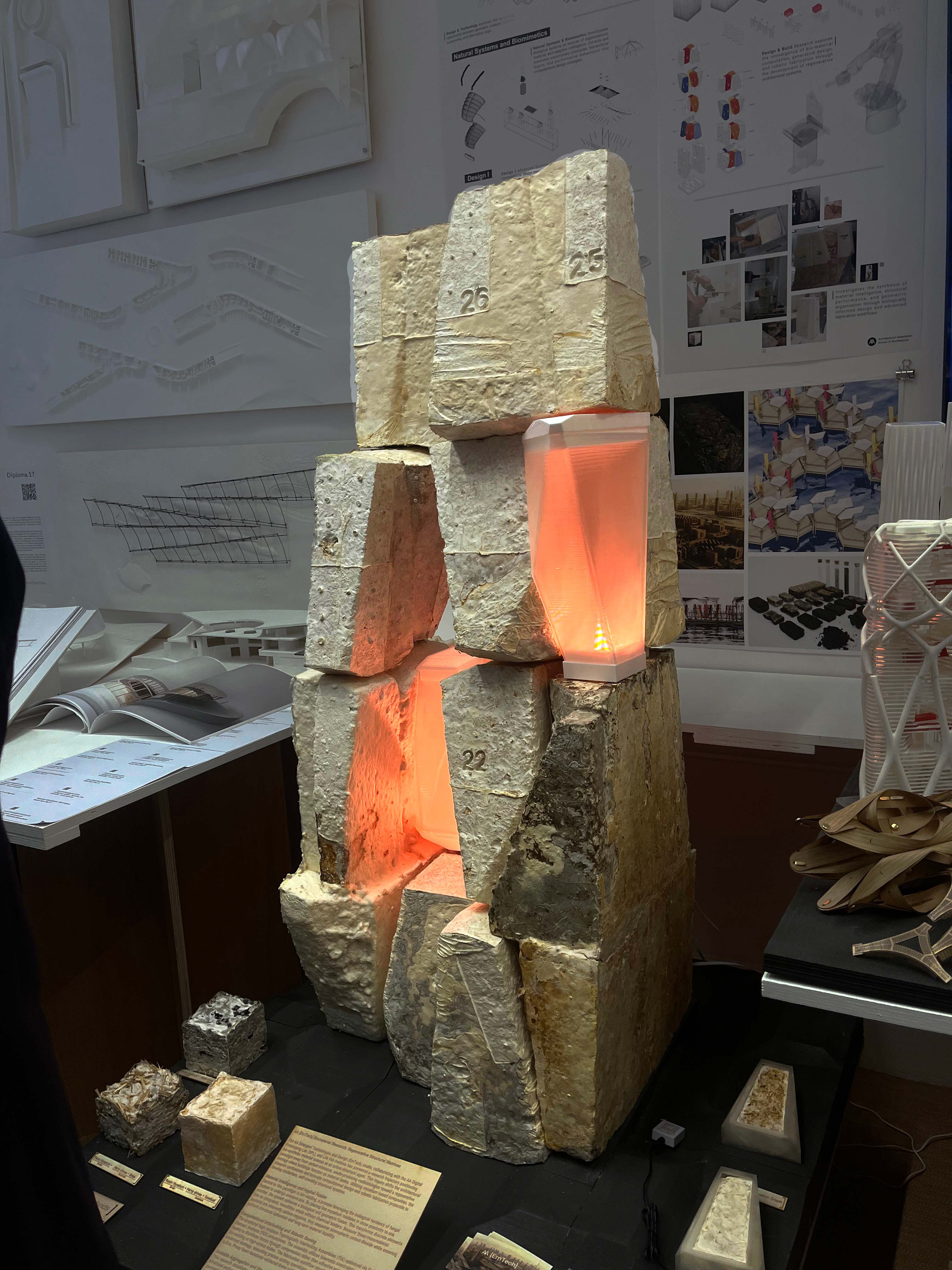
EmTech at the AA: Mycelium Pavillion
Challenge: to create and grow 50 mycelium blocks with architects for a free-standing pavillion design.
Approach: Introducing the basics of mycelium, including cultivation and maintenance, and developed an efficient way to produce multiple interlocking blocks within limited space and time.
Outcome: A free-standing sculpture from 43 mycelium blocks that were bio-welded together, serving as a first small-scale prototype for a larger future iteration.
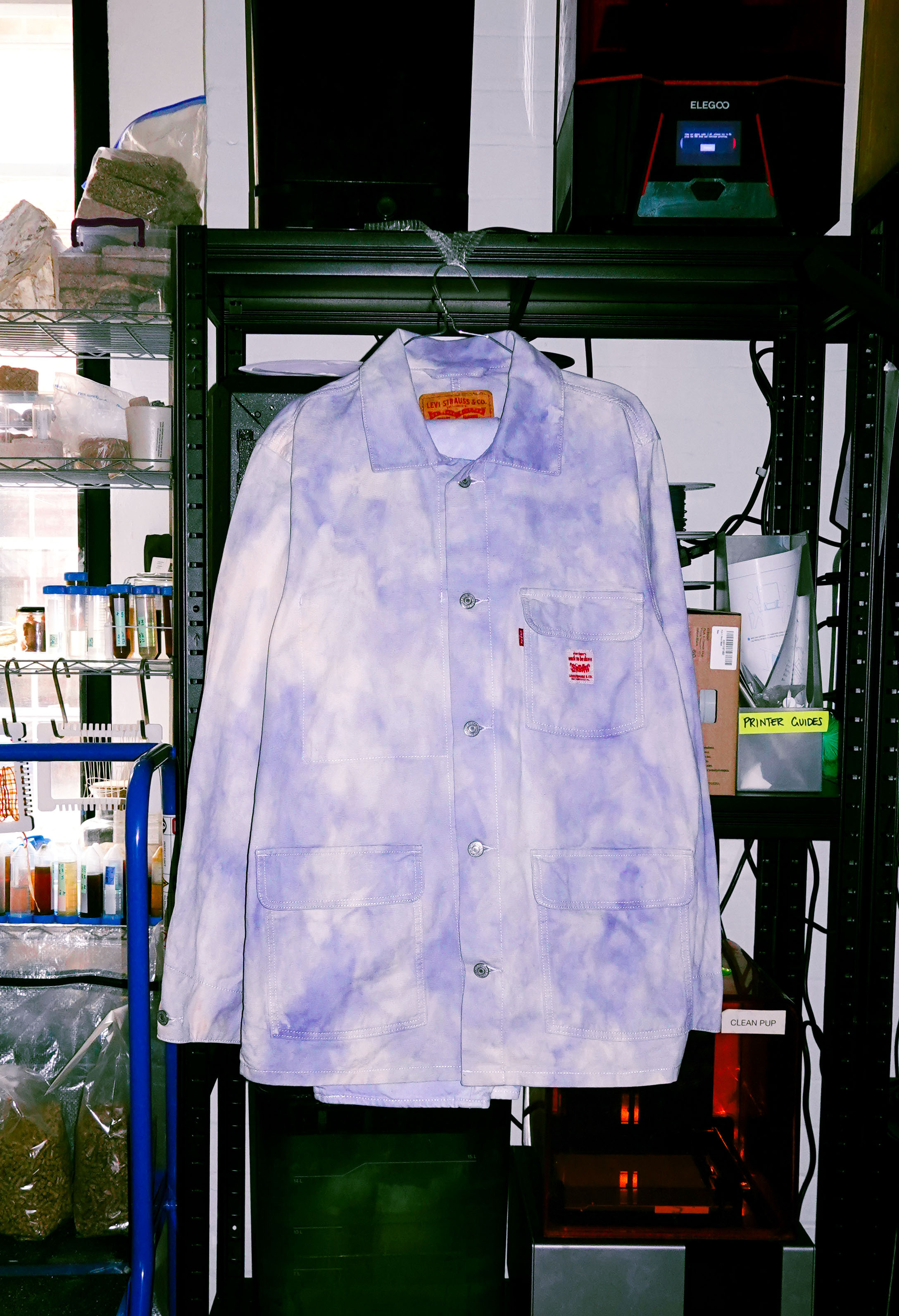
OpenAREA x Levis: Bacterial Dyed Jeans
Challenge: rapidly produce a full denim outfit for an artist, while ensuring the dye remained consistent across the whole set.
Approach: garment was dyed using blue pigment-producing bacteria, because denim and indigo has historically been an iconic pairing. We approached this familiar pairing through an innovative bacterial pigment application.
Outcome: a two-piece suit, shirt, and jeans fully dyed in a cloud-like pattern using pigment-producing bacteria.
Materiom: Polymer Development
Challenge: The project involved complex liquid-handling experimentation for polymer development for an LLM
Approach: An evolving sprint splitting across material development, robotics and analysis.
Outcome: A set of multiple protocol run-throughs, using different solutions and dispersions and a large data set of results.
NHS Hospitals: Advanced Surgical Printing
Challenge: To provide five major London NHS hospitals: UCLH, the Royal Free, GOSH, St Barts, and Queen Square, with affordable, rapid access to patient-specific anatomical models for surgical planning and training.
Approach: Working directly from patient MRI and CT scans, we developed a workflow to convert clinical imaging into accurate 3D-printed models in as little as two hours, printed in tissue-textured materials that let teams rehearse complex and rare conditions.
Outcome: Over 100 patient specific models produced and 60 surgeons trained.
OpenAREA x Levis: Bacterial Dyed Jeans
Challenge: rapidly produce a full denim outfit for an artist, while ensuring the dye remained consistent across the whole set.
Approach: garment was dyed using blue pigment-producing bacteria, because denim and indigo has historically been an iconic pairing. We approached this familiar pairing through an innovative bacterial pigment application.
Outcome: a two-piece suit, shirt, and jeans fully dyed in a cloud-like pattern using pigment-producing bacteria.
EmTech at the AA: Mycelium Pavillion
Challenge: to create and grow 50 mycelium blocks with architects for a free-standing pavillion design.
Approach: Introducing the basics of mycelium, including cultivation and maintenance, and developed an efficient way to produce multiple interlocking blocks within limited space and time.
Outcome: A free-standing sculpture from 43 mycelium blocks that were bio-welded together, serving as a first small-scale prototype for a larger future iteration.
.jpg)
Materiom: Polymer Development
Challenge: The project involved complex liquid-handling experimentation for polymer development for an LLM
Approach: An evolving sprint splitting across material development, robotics and analysis.
Outcome: A set of multiple protocol run-throughs, using different solutions and dispersions and a large data set of results.
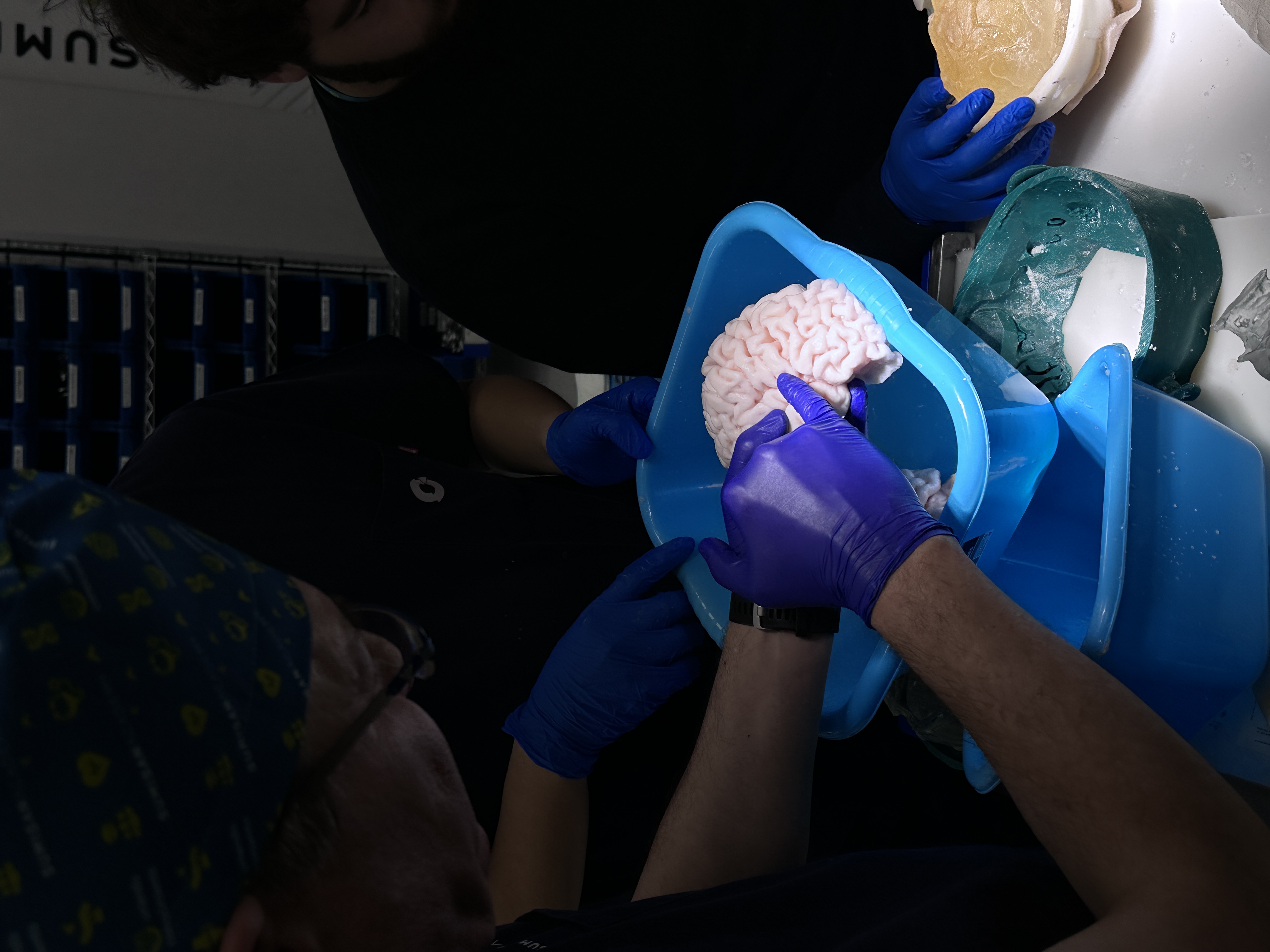
NHS Hospitals: Advanced Surgical Printing
Challenge: To provide five major London NHS hospitals: UCLH, the Royal Free, GOSH, St Barts, and Queen Square, with affordable, rapid access to patient-specific anatomical models for surgical planning and training.
Approach: Working directly from patient MRI and CT scans, we developed a workflow to convert clinical imaging into accurate 3D-printed models in as little as two hours, printed in tissue-textured materials that let teams rehearse complex and rare conditions.
Outcome: Over 100 patient specific models produced and 60 surgeons trained.
From a focused scoping sprint that defines a problem, to a short pilot that delivers early proof, to a full project once the idea is validated, you can work with us at whatever level of commitment fits:
Many partners return for the next stage or for an adjacent idea worth exploring, building an ongoing relationship over time.
You can collaborate with us once, or make us a long-term partner in your innovation, the choice is always yours.
Contact us here to collaborate.